Skip to content

2026 Top Water Oxygen Meter Types for Global Buyers

Water quality decisions increasingly depend on measurements that are fast, traceable, and practical in difficult field conditions. The WHO and UNICEF Joint Monitoring Programme reported that 2.2 billion people lacked safely managed drinking water services in 2022. This figure highlights the need for reliable monitoring, not merely better infrastructure. A Water Oxygen Meter helps buyers evaluate dissolved oxygen in aquaculture tanks, wastewater systems, laboratories, rivers, and process water.

The market includes optical, electrochemical, portable, benchtop, and inline oxygen meters. Optical sensors usually require less maintenance and avoid frequent electrolyte replacement. Electrochemical probes can offer strong value and familiar operation, but membrane care affects accuracy. ISO 5814 describes electrochemical oxygen determination, while Standard Methods 4500-O supports recognized dissolved oxygen testing procedures. The United States Environmental Protection Agency also identifies dissolved oxygen below 5 mg/L as stressful for many aquatic organisms, with lower levels creating serious hypoxia risks.

Small details matter. A muddy probe, trapped air bubble, or warm sample can change the reading. Temperature compensation helps, but it does not repair poor calibration. Buyers should compare accuracy, response time, salinity correction, calibration stability, IP rating, data logging, and replacement costs. UNESCO’s 2024 World Water Development Report connects water security with stronger monitoring and better decision-making. However, no instrument performs perfectly in every application. This guide compares major Water Oxygen Meter types for global buyers, while recognizing that local water chemistry, operator skill, and maintenance discipline can matter as much as the sensor itself.

2026 Top Water Oxygen Meter Types for Global Buyers

What Water Oxygen Meters Measure and Why They Matter

Water oxygen meters measure dissolved oxygen (DO), not the oxygen trapped above the surface. They report concentration in milligrams per liter (mg/L) or parts per million, plus saturation percentage. Temperature, salinity, pressure, and water movement can change the reading. A cool mountain stream may hold more oxygen than a warm, stagnant pond. That simple comparison shows why one number needs context. Many instruments also display temperature, because DO compensation depends on it. Without accurate temperature data, a precise-looking result may still mislead.

Different meter types suit different working conditions. Optical sensors use luminescent materials and usually need less maintenance. Electrochemical sensors measure oxygen through a membrane and electrolyte, requiring careful cleaning and calibration. Portable meters help technicians check tanks, rivers, and treatment basins at the sampling point. Benchtop models support controlled laboratory testing. In field work, I look for stable readings, an intact probe, and a calibration record. I also take duplicate measurements when water conditions shift quickly. Small details matter.

DO matters because fish, shellfish, and aerobic microorganisms depend on it. Low oxygen can stress aquatic life and reduce biological treatment performance. High oxygen readings may also deserve attention near intense aeration or algal activity. No meter is flawless. Bubbles on the probe, dirty membranes, and poor sample handling can create false confidence. I have found that waiting for a stable value is harder than expected. Results should be checked against site conditions, maintenance notes, and a recognized testing procedure. A number without those details is only half the measurement.

Main Water Oxygen Meter Types Available in 2026

2026 Top Water Oxygen Meter Types for Global Buyers

Main Water Oxygen Meter Types Available in 2026

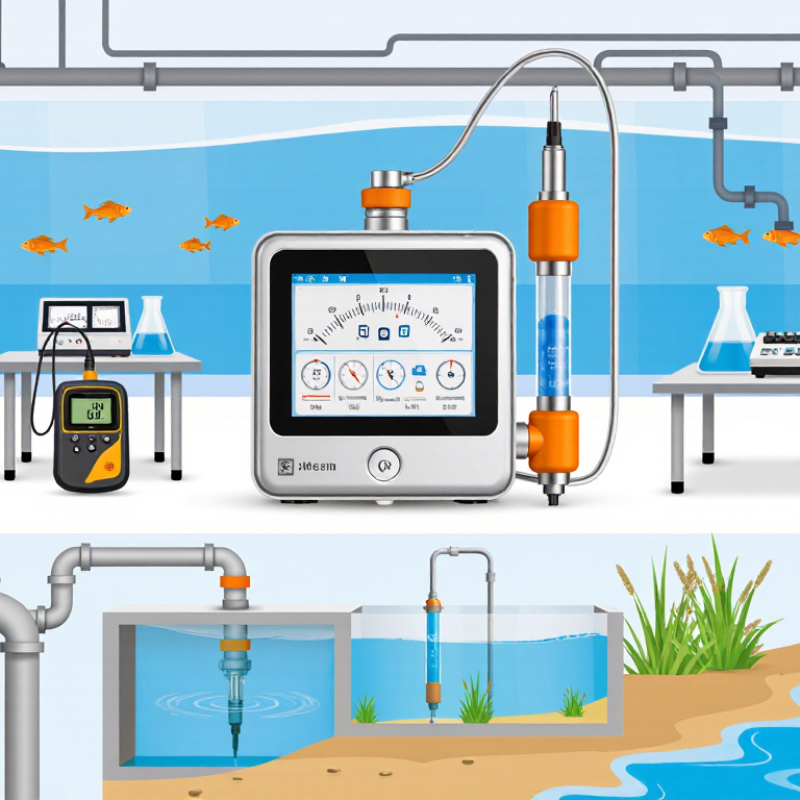
Water oxygen meters mainly use optical, polarographic, or galvanic sensing. Optical dissolved oxygen meters measure luminescence without consuming oxygen. They need fewer membrane changes and perform well in wastewater, aquaculture, and field sampling. Polarographic meters provide stable readings after polarization. Galvanic sensors start quickly, but their membranes and electrolyte require regular care. Portable meters suit rivers, tanks, and treatment sites. Benchtop models support repeatable laboratory testing, while online meters provide continuous process data.

FAO AQUASTAT reports that agriculture accounts for about 70% of global freshwater withdrawals. Oxygen control therefore matters in ponds, irrigation reservoirs, and reuse systems. The US EPA’s National Rivers and Streams Assessment includes dissolved oxygen among key water-quality indicators. This supports a practical buying rule: match the sensor to the water matrix, temperature range, and sampling frequency. No type wins every site. Even optical probes can drift in dirty water.

Tips: Check automatic temperature compensation, salinity correction, IP protection, calibration records, and replacement costs. Test a portable meter beside a laboratory instrument before large purchases. That step is often skipped. It should not be. ISO 5814 also emphasizes controlled electrochemical measurement procedures, so documented calibration remains essential for reliable international testing.

2026 Top Water Oxygen Meter Types for Global Buyers

Main Water Oxygen Meter Types Available in 2026

The chart shows the approximate dissolved oxygen concentration of freshwater at equilibrium with air at sea-level pressure. As water temperature rises, oxygen solubility decreases. This reference helps buyers evaluate whether a meter’s dissolved oxygen range is suitable for aquaculture, wastewater treatment, environmental monitoring, or laboratory work.

Optical Luminescent Meters

Use a fluorescent or luminescent sensor. They generally require less routine maintenance because there is no oxygen-consuming electrode reaction.

Polarographic Meters

Use a membrane-covered electrode with an applied polarization voltage. They are widely used for field and process measurements but require membrane and electrolyte care.

Galvanic Meters

Generate the measurement signal without external polarization. They can provide convenient field operation and are commonly used with replaceable membrane systems.

Winkler Titration Systems

Use a chemical fixation and titration procedure. This is a recognized reference method for dissolved oxygen analysis, although it is slower and less portable than electronic meters.

Values are approximate freshwater equilibrium concentrations in milligrams per liter (mg/L) at standard atmospheric pressure. Actual readings vary with salinity, altitude, pressure, water movement, and biological activity.

How Optical and Electrochemical Sensors Compare

2026 Top Water Oxygen Meter Types for Global Buyers

How Optical and Electrochemical Sensors Compare

Optical and electrochemical sensors remain the main choices for measuring dissolved oxygen in 2026. Optical meters use a light-sensitive layer that reacts with oxygen. They need little flow and do not consume oxygen during measurement. This helps in sealed tanks, slow streams, and laboratory samples. Their membranes usually last longer, but biofouling can still distort readings. Watch for bubbles.

Electrochemical sensors use a cathode, anode, and electrolyte solution. They respond quickly and often cost less at purchase. However, they consume oxygen while operating, so water movement matters. A still sample may produce a falsely low result. Regular membrane replacement and electrolyte checks are necessary. Temperature and salinity compensation also require careful setup.

Neither type wins in every environment. Optical meters suit long monitoring periods and limited maintenance access. Electrochemical meters can fit routine field testing with trained operators. In aquaculture, a dirty optical cap may create stable-looking errors. In wastewater, a worn electrochemical membrane may drift before failure becomes obvious. Calibration records matter more than many buyers expect. One rushed calibration can undermine an entire day of sampling. The better choice depends on water conditions, response time, service skill, and verification habits. Test the meter against a trusted reference when readings seem unusual.

Key Specifications for Global Buyer Evaluation

2026 Top Water Oxygen Meter Types for Global Buyers

Key Specifications for Global Buyer Evaluation

Water oxygen meters generally fall into optical, electrochemical, portable, and benchtop categories. Optical sensors reduce membrane maintenance and often perform well in muddy water. Electrochemical probes can provide strong accuracy, but their membranes and electrolyte require regular attention. Portable meters suit rivers, aquaculture tanks, and wastewater inspections. Benchtop models offer steadier control in laboratories.

Check the measurement range before comparing prices. A practical instrument may cover 0–20 mg/L dissolved oxygen, with percentage saturation readings for process work. Accuracy near ±0.1 mg/L is useful for demanding tests, while 0.01 mg/L resolution supports trend monitoring. Temperature compensation matters because oxygen solubility changes sharply between cold streams and warm tanks. Salinity and atmospheric-pressure correction are also important in coastal or elevated locations.

Calibration should be simple, traceable, and documented. Field technicians commonly verify readings against air-saturation procedures and compare them with a reference sample. ISO 5814 can guide dissolved oxygen measurement practices, but local procedures still need review. Look for automatic calibration records, replaceable sensor parts, data logging, and a clear display under sunlight. IP-rated protection, battery life, probe-cable length, and operating temperature affect daily reliability. A longer cable sounds helpful, yet it can increase handling problems. I have found that overlooked maintenance time often costs more than the original meter difference. Water quality is rarely uniform. Validate the instrument in the actual sample, not only in clean laboratory water.

Choosing the Right Meter for Different Water Applications

Choosing the right water oxygen meter starts with the application, not the screen design. For rivers and field surveys, a portable optical meter offers stable readings, low maintenance, and no membrane replacement. It suits repeated measurements from a shaded stream to a warm sampling bucket. APHA Standard Methods recommend reporting dissolved oxygen in milligrams per liter and percent saturation, because temperature and elevation affect interpretation.

Wastewater plants need stronger process control. An electrochemical probe can provide dependable readings when operators maintain membranes, electrolyte, and calibration. Optical probes reduce routine maintenance, but biofilm still causes trouble in aeration tanks. The U.S. EPA identifies dissolved oxygen as a core indicator in stream monitoring, while the 2024 UN World Water Development Report highlights agriculture’s approximately 70% share of global freshwater withdrawals. Irrigation users may therefore need a rugged meter for canals, reservoirs, and nutrient-sensitive ponds, rather than a laboratory instrument.

Aquaculture requires fast response and reliable alarms. Choose a meter with automatic temperature compensation, data logging, and a probe suitable for continuous immersion. Small tanks may benefit from a compact handheld unit. Large farms need fixed monitoring points. ISO 5814 describes electrochemical and optical procedures for dissolved oxygen measurement, yet field conditions remain imperfect. I would verify readings with a second method during commissioning. A clean probe can still report a misleading number.

2026 Top Water Oxygen Meter Types for Global Buyers - Choosing the Right Meter for Different Water Applications
Meter Type Measurement Principle Typical Dissolved Oxygen Range Typical Accuracy Response Time Best-Suited Water Applications Main Advantages Key Limitations Recommended Buying Considerations
Optical Luminescent DO Meter Measures the change in luminescence lifetime or intensity of a light-sensitive optical sensor when exposed to oxygen. 0–20 mg/L
0–200% saturation
Typically ±0.1–0.2 mg/L or ±1–2% of reading, depending on the model and operating range. Usually 5–60 seconds Drinking-water monitoring, rivers, lakes, aquaculture, wastewater treatment, field surveys and laboratories. No electrolyte refill; low maintenance; good stability; limited sensitivity to flow; no oxygen consumption during measurement. Optical caps require periodic replacement; sensor performance can be affected by coating, fouling, temperature and incorrect calibration. Check optical-cap service life, temperature compensation, salinity compensation, pressure correction, data logging and IP protection.
Polarographic Membrane DO Meter A polarized cathode reduces oxygen that diffuses through a membrane, generating a current proportional to oxygen concentration. 0–20 mg/L
0–200% saturation
Typically ±0.1–0.3 mg/L or ±1–2% of reading after proper calibration. Typically 30–90 seconds Wastewater process checks, environmental monitoring, aquaculture and general laboratory testing. Proven technology; widely understood; suitable for routine dissolved oxygen testing; replacement membranes are commonly available. Requires polarization before use; consumes oxygen; needs sufficient water movement; membrane and electrolyte maintenance are necessary. Verify warm-up time, membrane availability, electrolyte type, probe construction, stirring requirements and calibration workflow.
Galvanic Membrane DO Meter Anodes and cathodes generate a current through an electrochemical reaction without requiring external polarization. 0–20 mg/L
0–200% saturation
Typically ±0.2–0.5 mg/L or ±2–3% of reading. Typically 30–120 seconds Portable field testing, aquaculture ponds, surface water and basic wastewater inspections. Ready for use with little or no warm-up; simple operating procedure; generally economical for routine measurements. Consumes oxygen; sensor output may drift; membrane and electrolyte replacement are required; accuracy depends strongly on flow and maintenance. Consider sensor replacement cost, membrane durability, calibration stability, spare-part supply and performance in low-flow water.
Portable Multiparameter DO Meter Combines a dissolved oxygen probe with measurement channels for parameters such as temperature, pH, conductivity, salinity or turbidity. Commonly 0–20 mg/L
Up to 200% saturation
Depends on the installed probe; commonly ±0.1–0.3 mg/L for DO. Approximately 5–120 seconds, depending on the sensor type. Environmental inspections, aquaculture management, water-resource surveys, compliance sampling and field laboratories. Reduces the number of instruments; supports compensation for temperature, salinity and pressure; enables synchronized field records. Higher purchase cost; more complex calibration; probe maintenance differs by parameter; larger data-management requirements. Check the number of channels, probe interchangeability, GPS, wireless transfer, battery life, memory capacity and software compatibility.
Benchtop Laboratory DO Meter Uses an optical, polarographic or galvanic probe connected to a stable laboratory display and measurement platform. Commonly 0–20 mg/L
0–200% saturation
Often ±0.1 mg/L or better under controlled laboratory conditions, subject to the probe and calibration method. Typically 10–90 seconds Water-quality laboratories, wastewater testing, research, quality control and standard-method analysis. Large display; stable operation; advanced calibration records; improved sample handling; often supports GLP-style data management. Not designed for remote fieldwork; requires a controlled workspace; sample stirring and temperature equilibrium may affect results. Review data export, audit-trail functions, calibration reminders, stirrer compatibility, sample-volume requirements and laboratory temperature control.
Inline Process DO Transmitter A permanently installed optical or electrochemical sensor continuously measures dissolved oxygen in a pipe, channel or treatment basin. Commonly 0–20 mg/L
Some systems support extended ranges
Typically ±0.1–0.2 mg/L or ±1–2% of reading, depending on process conditions and sensor design. Usually 5–120 seconds Activated-sludge aeration control, industrial wastewater, water-treatment plants, fermentation and process-water systems. Continuous monitoring; supports alarms and control loops; reduces manual sampling; can improve aeration-management efficiency. Installation quality is critical; fouling, bubbles, vibration and changing flow conditions can affect readings; scheduled cleaning is required. Check mounting options, cleaning system, output signals, communication protocols, pressure rating, chemical compatibility and controller integration.
Submersible or Data-Logging DO Probe A sealed probe records dissolved oxygen and temperature at programmed intervals while deployed in a water body or monitoring station. Commonly 0–20 mg/L
0–200% saturation
Typically ±0.1–0.3 mg/L, depending on sensor technology, fouling protection and deployment conditions. Typically 5–120 seconds Long-term lake, river, reservoir, groundwater and aquaculture monitoring. Supports unattended monitoring; records trends over time; useful for identifying stratification, hypoxia and daily oxygen cycles. Biofouling and sediment accumulation can distort readings; battery capacity and memory limit deployment duration; retrieval may be required. Evaluate deployment depth, battery life, memory, anti-fouling protection, vented pressure compensation, retrieval accessories and data export.
Flow-Through DO Analyzer Measures dissolved oxygen in a continuously pumped sample stream passing through a controlled flow cell. Commonly 0–20 mg/L
Specialized ranges may be available
Typically ±0.1–0.2 mg/L when flow, temperature and pressure are controlled. Typically 10–90 seconds Laboratory water systems, boiler-feed and high-purity water checks, industrial process sampling and pilot plants. Provides consistent sample contact; suitable for continuous or semi-continuous sampling; easier to isolate from difficult process locations. Requires pumps, tubing and flow control; leaks or air ingress can cause errors; installation is more complex than handheld testing. Confirm wetted-material compatibility, flow requirements, pressure limits, sample conditioning, alarm outputs and maintenance access.
Portable Optical Spot DO Sensor Uses a compact optical sensing element for quick measurements at selected sampling points without continuous deployment. Commonly 0–20 mg/L
0–200% saturation
Typically ±0.2 mg/L or ±2% of reading. Usually 5–45 seconds Field screening, hatchery tanks, aquaculture sampling, educational laboratories and routine spot checks. Compact; simple operation; low oxygen consumption; convenient for repeated measurements at multiple locations. Less suitable for permanent process control; optical sensing elements need periodic verification and replacement. Prioritize portability, one-handed operation, waterproof construction, automatic stabilization, calibration prompts and replacement-sensor cost.
Winkler Titration Reference Method A chemically fixed water sample is titrated to determine dissolved oxygen concentration; it is a reference laboratory method rather than an electronic meter. Commonly suitable for approximately 0–20 mg/L Can provide high accuracy when sampling, fixation and titration are carefully controlled. Several minutes to hours, depending on sample handling and laboratory procedure. Method verification, instrument validation, research and situations where electronic sensors require an independent reference. No electronic sensor drift; useful for checking instrument performance; established analytical basis. Time-consuming; requires reagents and laboratory skill; sample must be fixed correctly; not suitable for real-time monitoring. Use only where trained personnel, appropriate reagents, safe chemical handling and controlled sampling procedures are available.
Measurement ranges and accuracy values are typical industry ranges rather than universal specifications. Actual performance depends on sensor technology, temperature, salinity, barometric pressure, water movement, fouling, calibration quality and the manufacturer’s stated operating conditions.
Back To Top