How to Choose the Right Spiral Heat Exchanger for Your Needs?
Choosing the right Spiral Heat Exchanger for your specific needs can be a challenging task. With the global heat exchanger market projected to reach $24 billion by 2026, the demand for efficient thermal management solutions is on the rise. Spiral heat exchangers stand out due to their compact design and superior performance in various industrial applications. According to a recent report from the Heat Transfer Society, spiral heat exchangers can improve thermal efficiency by up to 30% compared to traditional designs.
However, selecting the right model requires nuanced understanding. Factors such as operating conditions, fluid types, and space constraints influence your choice significantly. In practice, some users report difficulties with maintenance and cleaning of their spiral heat exchangers, which can affect overall reliability. Balancing these considerations is critical for optimal performance and cost efficiency.
Industry experts emphasize the need for careful analysis when investing in spiral heat exchangers. Relying solely on manufacturer specifications can lead to oversights. It is crucial to evaluate real-world performance and compatibility with existing systems. Ultimately, making informed decisions will enhance your facility's operational efficiency and longevity.
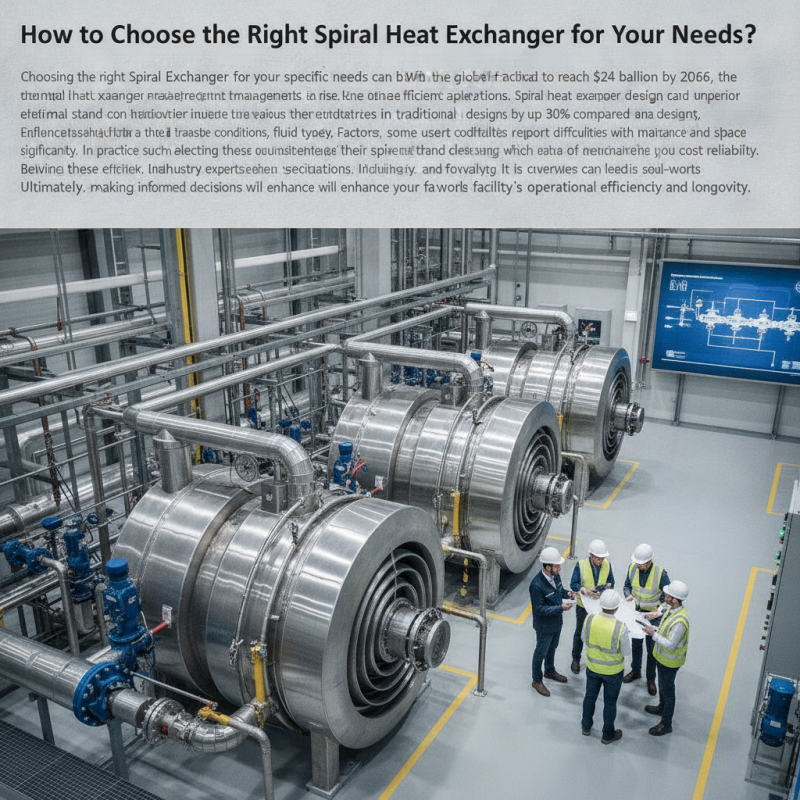
Understanding the Basic Principles of Spiral Heat Exchangers
When selecting a spiral heat exchanger, understanding its basic principles is crucial. Spiral heat exchangers transfer heat between two fluids. Their design features two spiral channels where these fluids flow. This structure maximizes heat transfer surface area, ensuring efficient energy exchange.
The flow arrangement in a spiral heat exchanger is unique. One fluid moves in a counter-current direction to the other. This configuration enhances thermal efficiency. However, not all spiral heat exchangers are the same. The material, diameter, and pitch of the spirals can vary. Consider these factors to match your specific needs effectively.
Another aspect to keep in mind is the maintenance requirement. Spiral heat exchangers can be complex. Their design may lead to difficulties in cleaning and repair. It's essential to consider how this complexity affects long-term performance. Investing in a suitable model is vital. Make sure it aligns with your operational needs and constraints.
Identifying Your Specific Heating and Cooling Requirements
Choosing the right spiral heat exchanger starts with understanding your specific heating and cooling requirements. Ask yourself what temperature ranges you need to maintain. Consider the flow rates of your fluids. High flow rates may require different designs. Take into account the types of fluids you will be using. Are they corrosive? Viscous? Each of these factors plays a crucial role in determining the right system.
Evaluating your process can be complex. Look at your energy consumption patterns. This can highlight inefficiencies. Analyze if you need a compact design. Space constraints might push you towards a smaller unit, but could sacrifice efficiency. It's essential to balance performance with the constraints of your facility.
Reflect on how your requirements might change in the future. Will your production scale up? Will your fluid characteristics shift? It's wise to choose an adaptable design that can grow with you. Testing out smaller models or configurations can provide insight into your overall needs. Be prepared to make adjustments as you gather more data. Understanding your specific heating and cooling needs ensures better performance and reliability in your operations.
Heat Exchanger Efficiency Comparison
Evaluating Material Compatibility for Your Applications
Choosing the right spiral heat exchanger requires careful consideration of material compatibility. Different materials respond uniquely to various fluids, temperatures, and pressures. For instance, stainless steel performs well with many chemicals but may corrode when exposed to certain acidic environments. It's crucial to analyze the specific application and the fluids used.
One common oversight is underestimating temperature effects. Some materials may fail at high temperatures while others may lose strength over time. For example, Hastelloy offers excellent high-temperature resistance, but its cost can be a barrier. Ease of maintenance is another aspect often overlooked. Complex designs can complicate cleaning, impacting long-term efficiency.
Always consult with industry experts or engineers when selecting materials. Their experience can guide you in making informed decisions. Testing with small samples can also reveal unexpected interactions. Understanding these factors can prevent costly mistakes and ensure optimal performance of your heat exchanger.
Assessing Size and Capacity Needs for Efficiency
When selecting a spiral heat exchanger, size and capacity are crucial. Assessing your system's flow rates is necessary. The Heat Exchange Institute suggests that appropriate sizing can enhance thermal efficiency by up to 30%.
Flow rate mismatches can create inefficiencies. Oversized exchangers may lead to lower heat transfer rates or higher pressure drops. According to a 2022 report by the International Journal of Heat and Mass Transfer, optimizing the sizing could save companies up to 25% on operational costs.
Consider your specific applications. Calculate the desired output and the heating or cooling requirements. An understanding of your process can prevent costly mistakes. Regular evaluations of heat transfer performance are essential. These steps ensure long-term reliability and efficiency in operations.
Considering Maintenance and Cost Factors for Long-Term Use
When selecting a spiral heat exchanger, maintenance and cost are critical factors. Regular maintenance extends the lifespan of the equipment. A report from the Heat Exchange Institute indicates that proper upkeep can improve efficiency by 30%. This efficiency increase translates to lower operational costs over time. Neglecting maintenance can lead to reduced performance, with potential cost surges by up to 25% due to system failures.
The initial acquisition cost shouldn't overshadow long-term expenses. A reliable study reveals that spirals are often more cost-effective than other heat exchanger types. However, system design must be adapted to minimize fouling. Choosing materials wisely can also impact both performance and longevity. Improper material choices can result in corrosion and leaks, leading to unexpected repair costs. These factors necessitate careful consideration and assessment during the selection process.
Decisions must weigh these maintenance needs and total costs. An initial investment in quality components can lead to significant savings. Yet, companies often struggle with balancing upfront and ongoing costs. Many overlook the importance of choosing the right design and materials. Awareness of these factors is essential for optimizing system performance over time.
